

PARIS (CN) - When Sebastien Lecornu became the latest in a revolving door of French prime ministers in September 2025, his message was clear: He would rely on compromise and dialogue, rather than pushing his agenda through by force like many of his predecessors.
That posture won him some praise, especially after he narrowly avoided a government collapse last month by weaving a complicated web of deals and concessions across a Parliament where no group holds a majority.
But this week, he made a clear break from that promise - Lecornu enacted constitutional article 49.3, which allows the government to pass bills without a vote, to ram the 2026 state budget into effect.
The move triggered two motions of censure - one from the extreme-right National Rally, and another from the left-wing bloc excluding the Socialists - which were put to a vote Friday.
"You have failed politically, your approach is purely political," the National Rally's leader Marine Le Pen declared Friday morning, speaking to a largely empty hemicycle in the National Assembly, France's lower chamber of Parliament. "The coming months will be a political descent into hell for you."
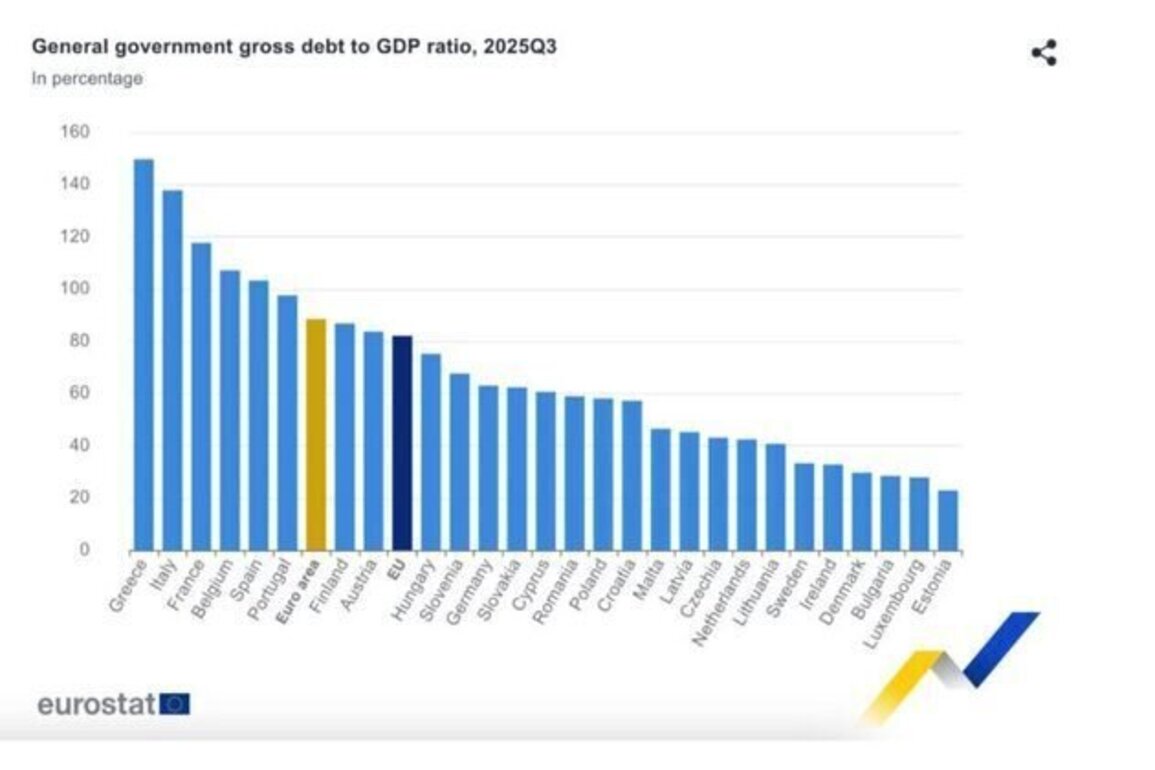
The country is in the midst of a financial crisis, with a budget deficit of about 5.4% of GDP last year - well over the 3% limit set by the European Union. Public debt rose to $4.1 trillion, or 117% of GDP in 2025, from 97.4% in 2019, according to the National Institute of Statistics and Economic Studies. The eurozone average is under 90%.
France's budget was the final nail in the coffin for Lecornu's two most recent predecessors, Francois Bayrou and Michel Barnier, who were ousted after failing to present convincing drafts. So the pressure was on for Lecornu to merely survive and keep the government running.
Lecornu defended his decision to use the 49.3 as a "last resort" when parties are looking to oust the government, rather than working toward agreement. It's often called the "nuclear option."
"How does a democracy decide when it reaches the point where no one wants to decide anymore?" he asked the hemicycle. "This budget is uncomfortable because it doesn't belong to anyone, or rather, it belongs to a little bit of everyone."
Lecornu narrowly survived the left-wing motion; there were 269 votes against Lecornu, 19 fewer than the 288 needed to be successful. The right-wing margin was wider, when 142 lawmakers voted against the prime minister.
But his adversaries aren't giving up. Early Friday afternoon, Lecornu announced he would enact Article 49.3 again in order to pass the spending section of the budget, which immediately triggered two new motions of censure from the same groups. Legislators will vote on them Tuesday.
Yal Braun-Pivet, president of the National Assembly, urged lawmakers to refocus their attention onto who's really important here - the people of France.
"[I regret that] the budget could not be voted on by Parliament," she said. "But the adoption of the expenditure section, after the rejection of two motions of censure, meets the expectations of the French: to provide France with a budget."

Gilbert Casasus, a prominent political scientist, sees two different interpretations of Lecornu's use of the measure.
"The first is, never promise something you can't deliver," he said. "It's a strategic error he made because this 49.3, which has had very bad press, can nevertheless serve the interests of parliamentarians and the executive power when there is a deadlock."
But in his view, the second interpretation is that he didn't have any other choice.
"The problem isn't the 49.3 in and of itself, it's not Lecornu in and of himself," he said. "The problem is that today, there is no majority in France, and because there is no majority in France, well quite simply, this country is becoming ungovernable."
Luc Rouban, a senior research fellow at Sciences Po Paris, agreed.
"Actually, it was quite logical that the Lecornu government use the 49.3," Rouban said.
But Article 49.3 is still a sore spot in France's collective imagination. In 2023, it was used to push through French President Emmanuel Macron's controversial pension reform, which raised the retirement age from 62 to 64. This triggered months of protests across the country, and opened widespread criticism of the measure as an undemocratic tool.
While Lecornu made a major concession on pension reforms, which will put off raising the retirement age until the 2027 presidential elections, there are still major disagreements. The left wants to raise taxes on high-income earners, for one, while the right is fighting the move.
In this case, Thomas Guenole, a political scientist and author of "The Art of Always Being Right When You're on the Left," cautions the move could cause distrust between the Socialist party and its voters.
The Socialists did not vote for the left's motion of censure, essentially signifying a break in the left-wing alliance that won the most seats in France's 2024 snap legislative elections and prevented the right from coming into power.
"And so they took the risk of cutting their alliance during the current legislative session," Guenole said. "Except that if tomorrow there's a dissolution of the National Assembly because the government has fallen, in the absence of an alliance on the left, the Socialist deputies are going to get wiped out."
The rift has been obvious for months. But Guenole argues that the Socialist vote was motivated by the desire to stay in power, more than passing a satisfactory budget for their electorate.
"The left-wing electorate is going to realize that the Socialist Party is taking them for fools - I think a certain number of deputies don't get out of their microcosm enough and don't realize how obvious their tricks are," he said. "And it's very, very annoying for a whole segment of the electorate that ... therefore feels insulted in their intelligence."
The budget circus is expected to continue until at least the end of the month, and both sides of the spectrum will likely issue multiple motions of censure until then.
For Casasus, the issue is exposing a wider issue in France's current political regime, established in 1958 under Charles de Gaulle.
"Personally, I believe that the Fifth Republic is dying and that we should broadly consider establishing very important institutional reforms, even a Sixth Republic," he said. "This Fifth Republic has reached the end of a certain logic."
Source: Courthouse News Service